

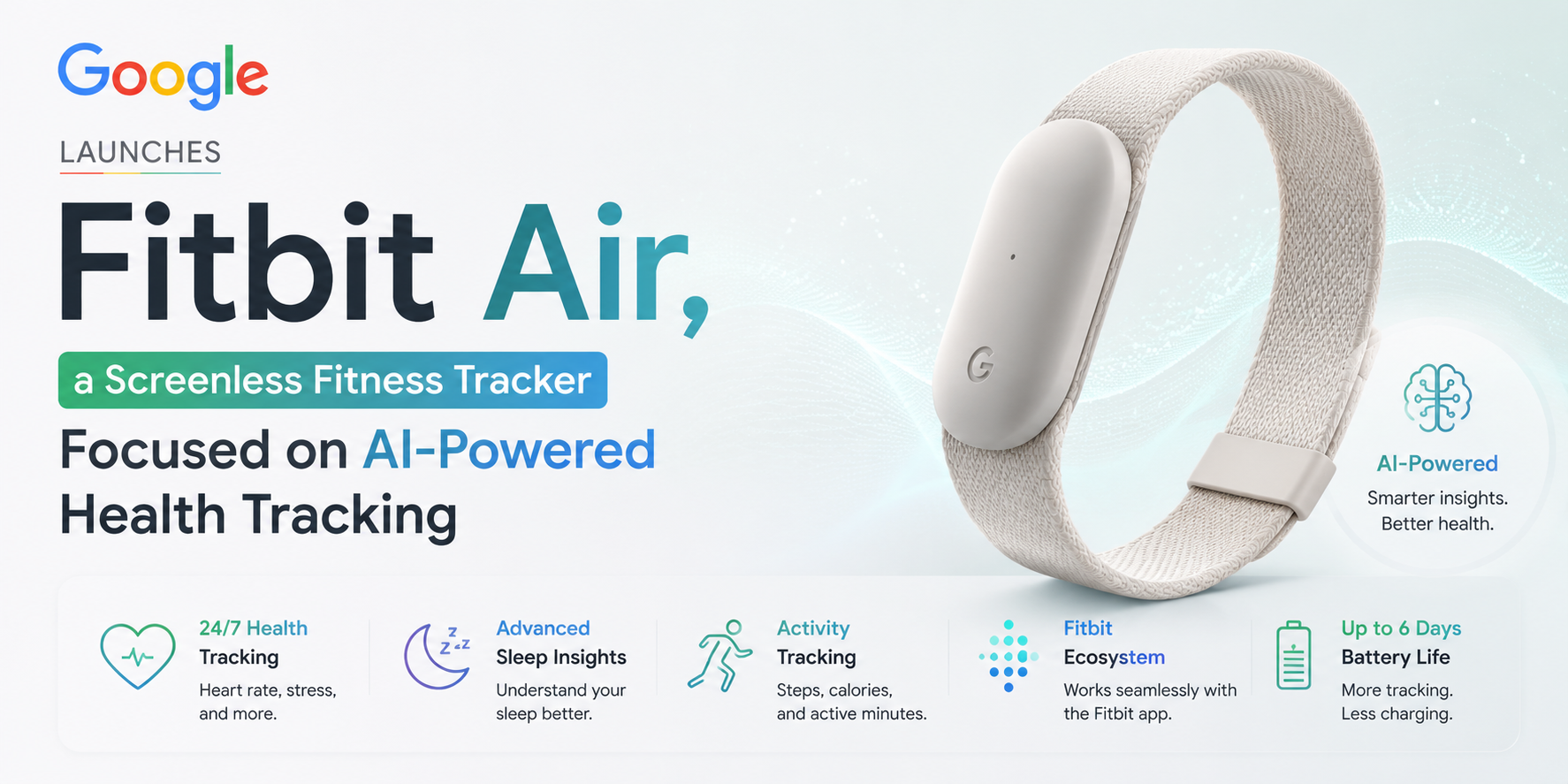
Google has officially unveiled the all-new Fitbit Air, introducing a completely different approach to wearable fitness technology. Unlike traditional smartwatches and fitness bands, the Fitbit Air comes without a screen, focusing entirely on health tracking, comfort, and AI-powered wellness insights.
The launch marks one of Google’s biggest wearable announcements since acquiring Fitbit and signals a major shift toward minimalist, distraction-free health devices. The Fitbit Air has been designed for users who want continuous health tracking without constant notifications, apps, or digital distractions.
Industry experts are already calling the Fitbit Air Google’s answer to popular screenless wearables like Whoop and Oura, as competition in the health-tech market continues to grow rapidly.
What Is Fitbit Air?
The Fitbit Air is Google’s newest lightweight fitness tracker built around a screenless “pebble-style” design. Instead of displaying data directly on the device, the tracker syncs with the newly introduced Google Health app, where users can monitor health metrics, workouts, sleep patterns, and recovery insights.
Google says the product was created to provide a simpler and more comfortable wearable experience for users who do not want bulky smartwatches or constant notifications throughout the day.
The device is also significantly lighter than many existing fitness trackers and is designed for 24/7 wear.
According to reports, Fitbit Air is around 20% lighter than the discontinued Fitbit Luxe fitness band.
Why Google Removed the Screen
One of the biggest talking points around Fitbit Air is Google’s decision to completely remove the display.
According to Google, the goal was to reduce distractions and encourage users to focus on their daily lives instead of constantly checking notifications or workout stats.
The company describes Fitbit Air as a “background wellness device” that quietly tracks biometric data throughout the day while delivering insights later through the smartphone app.
This approach reflects a growing trend in the wearable industry where consumers increasingly prefer minimal, screen-free devices focused on long-term health monitoring rather than smartwatch functionality. (turn0news26)
Fitbit Air Features and Health Tracking Capabilities
Despite its minimal design, Fitbit Air includes several advanced health and fitness tracking features.
The wearable supports:
1. Activity tracking
2. 24/7 heart-rate monitoring
3. Sleep tracking
4. Blood oxygen (SpO2) monitoring
5. Skin temperature tracking
6. Heart rhythm monitoring
7. Stress and recovery insights
8. Workout auto-detection
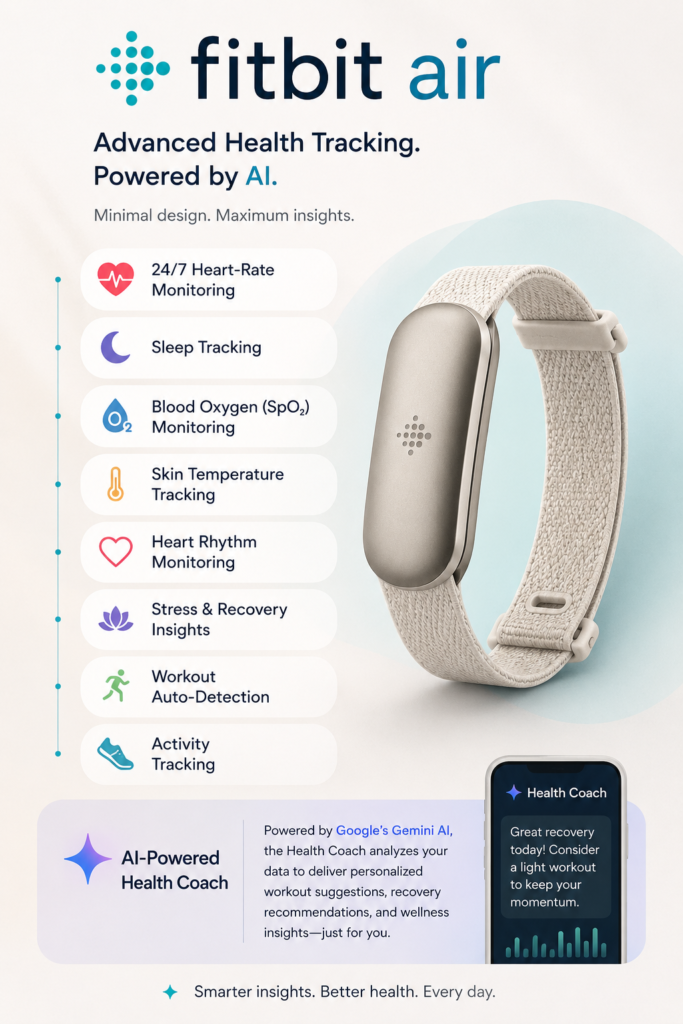
The device also uses AI-powered wellness recommendations through Google’s Gemini-based Health Coach system. The AI coach analyzes user health data and provides personalized workout suggestions, recovery recommendations, and wellness insights.
This move highlights Google’s increasing focus on AI-driven healthcare and personalized digital wellness tools.
Google Health App Replaces Fitbit App
Alongside Fitbit Air, Google also introduced the new Google Health app, which will gradually replace the traditional Fitbit app and eventually absorb Google Fit services.
The new app combines:
- Fitbit tracking data
- AI-powered coaching
- Sleep analytics
- Health dashboards
- Medical record integration
- Third-party health app support
Google says the platform is designed to create a unified health ecosystem across Android devices, Pixel products, and future wearable technologies.
The Google Health app is expected to roll out globally on Android and iOS later this month.
Fitbit Air Price and Availability
Google has priced the Fitbit Air at $99.99, making it one of the company’s most affordable health wearables.
Pre-orders have already started in select markets, while the official launch is scheduled for May 26, 2026.
Google is also offering:
- multiple interchangeable bands,
- fashion-focused designs,
- and special athlete-inspired editions.
One of the special editions was designed in collaboration with NBA star Stephen Curry, who has reportedly been testing the wearable for months.
Battery Life and Design
Google claims Fitbit Air offers up to seven days of battery life on a single charge.
The company says the screenless design helps improve battery efficiency while also making the device smaller and more comfortable.
The wearable features:
- water resistance,
- swappable straps,
- lightweight construction,
- and discreet styling suitable for all-day wear.
Unlike traditional smartwatches, Fitbit Air is designed primarily as a passive health companion rather than an interactive wearable.
Competing With Whoop and Oura
Many analysts believe Fitbit Air directly targets the growing market for subscription-based wellness devices like Whoop and smart rings like Oura.
The wearable industry has recently seen rising demand for screenless health devices because users increasingly prefer:
- better battery life,
- continuous biometric tracking,
- reduced distractions,
- and minimalist designs. (turn0news26)
Google’s advantage lies in its ecosystem integration, AI capabilities, and lower pricing strategy.
Unlike some competitors, Fitbit Air can also function without a mandatory subscription, although premium AI coaching features are available through Google Health Premium.
A New Direction for Fitbit Under Google
The launch of Fitbit Air also reflects how Fitbit’s identity has evolved since Google acquired the company in 2021.
Over the past few years, Google gradually integrated Fitbit services into its broader hardware and software ecosystem, including Pixel devices and Google AI services.
With Fitbit Air and the Google Health platform, Google appears to be shifting Fitbit away from traditional fitness bands toward AI-powered digital health solutions.
Industry experts believe this could shape the future of wearable technology over the next several years.
Conclusion
The launch of Fitbit Air marks a major moment for Google’s wearable technology strategy. By removing the screen and focusing entirely on AI-powered health tracking, Google is targeting users who want smarter wellness tools without the distractions of modern smartwatches.
With advanced health sensors, week-long battery life, AI coaching, and deep integration with the new Google Health app, Fitbit Air represents a significant shift toward minimalist and personalized digital healthcare.
As the wearable market continues evolving, Fitbit Air could become one of the most important products shaping the future of screenless health technology.