

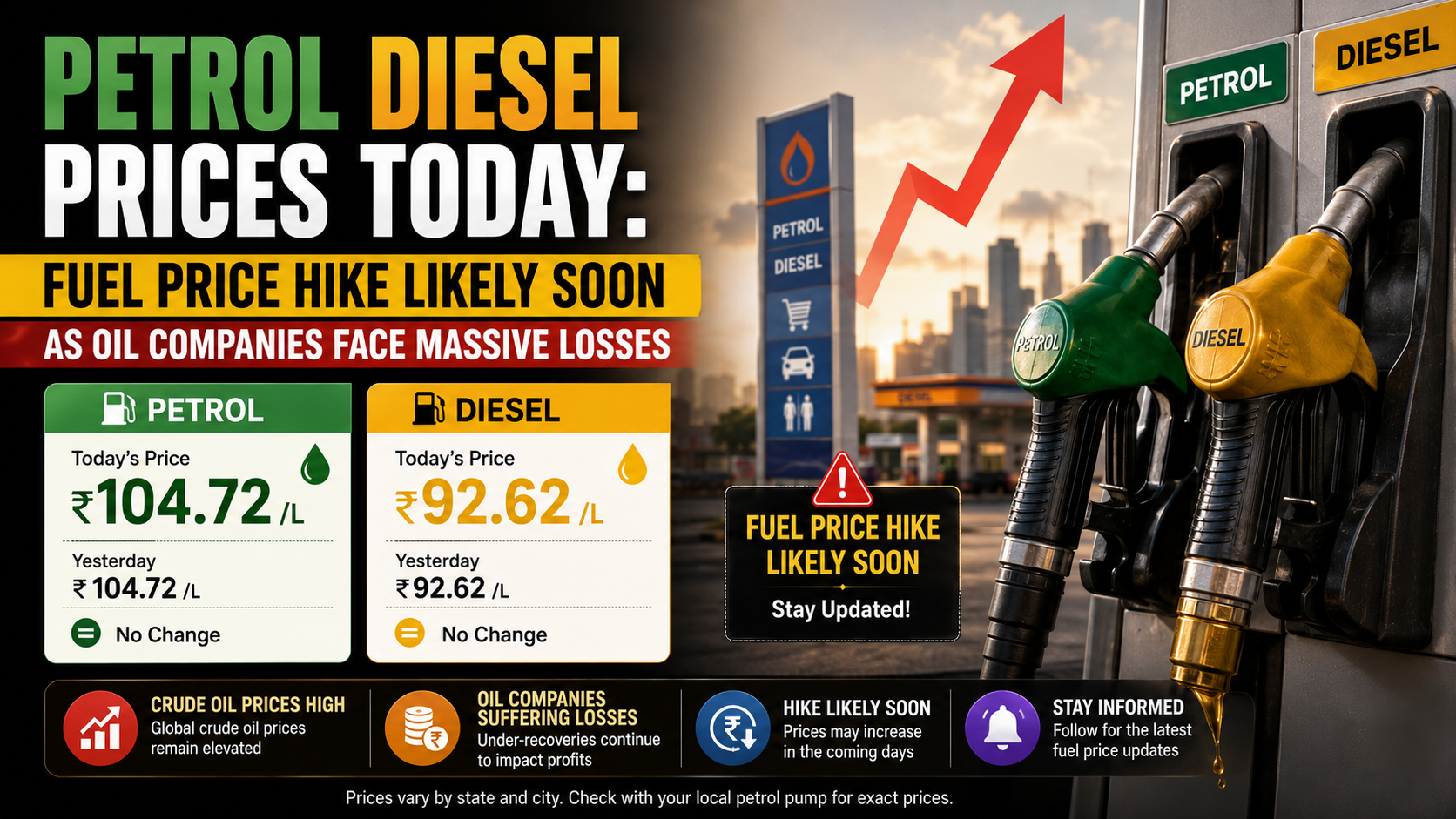
Petrol and diesel prices in India could soon witness another round of hikes as state-run oil marketing companies (OMCs) continue facing massive financial losses amid rising global crude oil prices and escalating tensions in West Asia. According to recent reports, Indian OMCs are currently suffering under-recoveries of nearly ₹30,000 crore every month while continuing to keep retail fuel prices stable across the country.
Although petrol and diesel prices remained unchanged in major Indian cities on May 11, 2026, experts believe the current pricing situation may not remain sustainable for much longer.
Economists and market analysts now expect calibrated fuel price hikes to begin after May 15 if global crude oil prices remain elevated.
Current Petrol and Diesel Prices in Major Indian Cities
As of today, fuel prices in major Indian cities remain largely unchanged.
Petrol Prices Today
- Delhi: ₹104.41 per litre
- Mumbai: ₹110.53 per litre
- Kolkata: ₹106.03 per litre
- Chennai: ₹101.63 per litre
- Bengaluru: ₹103.94 per litre
Diesel Prices Today
- Delhi: ₹89.67 per litre
- Mumbai: ₹97.28 per litre
- Kolkata: ₹92.76 per litre
- Chennai: ₹93.22 per litre
- Bengaluru: ₹89.02 per litre
Despite rising international oil prices, domestic retail rates have remained stable due to government intervention and the financial burden being absorbed by oil companies.
Why Fuel Prices May Increase Soon
The biggest reason behind the expected fuel price hike is the sharp increase in global crude oil prices.
Brent crude recently crossed $105 per barrel amid growing geopolitical tensions in West Asia, particularly concerns surrounding the US-Iran conflict and disruptions near the Strait of Hormuz — one of the world’s most important oil shipping routes.
India imports more than 85% of its crude oil requirements, making domestic fuel prices highly sensitive to international market movements.
As crude prices continue rising, oil companies are finding it increasingly difficult to maintain current retail fuel rates without suffering heavy losses.
OMCs Losing Around ₹30,000 Crore Every Month
Government officials recently confirmed that state-run oil companies including:
- Indian Oil Corporation (IOC),
- Bharat Petroleum Corporation Limited (BPCL),
- and Hindustan Petroleum Corporation Limited (HPCL)
are collectively facing under-recoveries of approximately ₹30,000 crore per month.
These losses are occurring because OMCs are selling:
- petrol,
- diesel,
- and LPG
below market-linked prices despite rising international crude oil rates.
According to reports, OMCs are currently facing:
- losses of nearly ₹20 per litre on petrol,
- and almost ₹100 per litre on diesel under prevailing global oil conditions.
Industry experts warn that such losses cannot continue indefinitely without impacting the financial stability of oil companies.
Fuel Price Hike Expected Around May 15
Several economists believe fuel price revisions are now highly likely after May 15.
According to Manoranjan Sharma, Chief Economist at Infomerics Ratings:
“With Brent crude above $105 per barrel, fuel price hikes after May 15 are highly likely.”
Reports suggest:
- petrol and diesel prices may rise by ₹4–5 per litre,
- while LPG cylinder prices could increase by ₹40–50.
However, experts also clarified that the government is unlikely to approve a sudden steep hike immediately because it could sharply increase inflation and public dissatisfaction.
Experts Predict Gradual Increase Instead of Sudden Shock
Economists believe India may adopt a gradual fuel price adjustment strategy rather than implementing a large one-time increase.
According to experts:
- smaller hikes of ₹2–4 per litre spread over time are more likely,
- helping reduce inflation impact on consumers and businesses.
Dr VK Vijayakumar of Geojit Investments stated that gradual increases would be easier for both consumers and the economy to absorb compared to a sudden steep hike.
This strategy may also help the government balance:
- inflation management,
- fiscal deficit concerns,
- and public sentiment.
PM Modi’s Fuel Conservation Appeal Gains Attention
Prime Minister Narendra Modi recently appealed to citizens to reduce unnecessary fuel consumption amid rising global energy prices and geopolitical uncertainty.
The Prime Minister advised people to:
- use public transport,
- avoid unnecessary travel,
- adopt carpooling,
- and encourage work-from-home practices wherever possible.
Economists believe the appeal reflects growing concern within the government regarding:
- rising import bills,
- fuel subsidy pressures,
- and worsening OMC losses.
Opposition parties, however, criticized the timing of the appeal and alleged that it may signal upcoming fuel price hikes after state election results.
How Higher Fuel Prices Could Impact Consumers
Fuel price hikes generally affect much more than transportation costs alone.
If petrol and diesel prices rise significantly, consumers may also experience:
- higher food delivery charges,
- increased transport fares,
- expensive logistics costs,
- rising airfares,
- and costlier goods and services.
Since fuel prices directly influence transportation and supply chains, even moderate increases often contribute to overall inflation in the economy.
Economists warn that sustained crude oil prices above $100 per barrel could significantly impact India’s inflation outlook in the coming months.
Government Earlier Reduced Excise Duty
To shield consumers from rising international crude prices, the government had earlier reduced excise duty on petrol and diesel.
Officials stated that the excise duty cut resulted in the government foregoing approximately ₹14,000 crore in monthly revenue.
However, despite these measures, OMCs continue facing severe financial stress because global crude prices have remained elevated for an extended period.
Analysts now believe policymakers may soon need to choose between:
- protecting consumers,
- reducing fiscal pressure,
- or improving OMC balance sheets.
Why Global Oil Prices Are Rising
Global oil markets have become increasingly volatile due to:
- ongoing West Asia conflict,
- uncertainty around Iran,
- supply chain disruptions,
- and fears surrounding the Strait of Hormuz shipping route.
The Strait of Hormuz is one of the world’s most critical oil transportation corridors, and any disruption there directly affects global crude oil prices.
Analysts say geopolitical tensions have significantly increased concerns about future oil supply stability, pushing crude prices higher globally.
What Experts Expect Next
Market experts believe fuel prices in India will largely depend on:
- global crude oil movement,
- geopolitical developments,
- government intervention,
- and OMC financial conditions.
If crude oil prices cool down due to easing tensions, India may avoid major fuel price hikes. However, if international oil prices remain above $100 per barrel for a prolonged period, fuel price revisions may become unavoidable.
For now, consumers are likely to face gradual adjustments rather than an immediate large increase at fuel stations.
Conclusion
Petrol and diesel prices in India remain stable for now, but growing financial pressure on oil marketing companies and rising global crude oil prices suggest that fuel price hikes may soon become unavoidable.
With OMC losses reportedly touching ₹30,000 crore every month and Brent crude trading above $105 per barrel, economists believe gradual fuel price increases could begin after May 15.
As global geopolitical tensions continue impacting energy markets, consumers, businesses, and policymakers will closely monitor fuel prices over the coming weeks.