

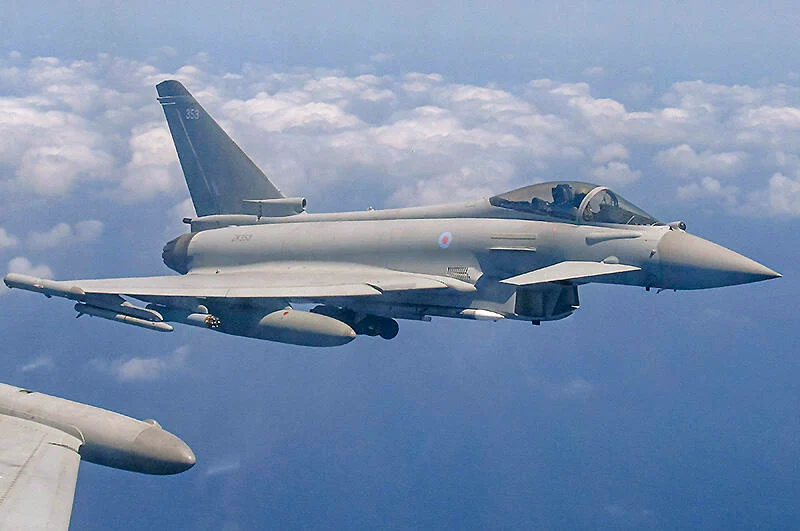
The Royal Air Force’s Eurofighter Typhoon fighter jet has officially received a powerful new anti-drone capability as Western militaries continue responding to the growing threat of unmanned aerial attacks in the Middle East. The upgraded system allows the Typhoon to launch Advanced Precision Kill Weapon System (APKWS) missiles, giving the aircraft a faster and more cost-effective way to destroy hostile drones.
The development comes at a time when drone warfare is rapidly reshaping global military operations. Cheap attack drones and unmanned aerial systems have increasingly become a major challenge for defence forces worldwide, especially in conflict zones across the Middle East.
Military analysts believe the new APKWS integration could significantly improve the RAF’s ability to intercept drones without relying on expensive long-range missiles.
What Is the APKWS Missile System?
The APKWS, or Advanced Precision Kill Weapon System, is a laser-guided rocket system developed by BAE Systems. It converts traditional unguided rockets into precision-guided weapons using laser guidance technology.
Originally designed for helicopters and ground-attack aircraft, the APKWS system has now been adapted for use on the Eurofighter Typhoon.
The missile system is considered highly effective against:
- drones,
- small aerial threats,
- lightly armoured vehicles,
- and low-cost battlefield targets.
Experts say one of the biggest advantages of APKWS is affordability. Traditional air-to-air missiles used against drones can cost hundreds of thousands or even millions of dollars, while APKWS rockets are significantly cheaper and more practical for targeting low-cost unmanned threats.
Why Drone Threats Are Increasing
Drone warfare has expanded dramatically over the last few years. Conflicts in:
- Ukraine,
- the Red Sea,
- Syria,
- and the Middle East
have shown how small drones can disrupt military operations and threaten expensive defence systems.
Iran-backed militant groups and other armed organizations have frequently used drones for:
- surveillance,
- kamikaze attacks,
- and missile delivery operations.
Western military bases and commercial shipping routes have increasingly faced drone attacks, particularly around the Red Sea region. (reuters.com )
Because many drones are cheap to manufacture, militaries have struggled with the economic imbalance of using extremely expensive missiles to shoot them down.
The APKWS system aims to solve that problem.
RAF Testing Focused on Middle East Operations
According to reports, the RAF’s APKWS-equipped Eurofighter Typhoon has already undergone operational testing focused on Middle East threat scenarios.
The RAF has been actively involved in air security operations across the region, especially as tensions linked to Iran-backed drone activity continue increasing.
Defence officials believe the Typhoon’s speed, radar systems, and maneuverability combined with APKWS missiles could make it one of the most effective anti-drone fighter platforms currently in service.
Military experts say the system is especially useful for:
- intercepting slower unmanned aircraft,
- defending military bases,
- and protecting naval operations.
Eurofighter Typhoon Continues Expanding Its Combat Role
The Eurofighter Typhoon was originally designed as an air-superiority fighter aircraft focused mainly on dogfighting and air defence. However, over time, the aircraft has evolved into a multi-role combat platform capable of:
- air-to-air combat,
- precision strikes,
- reconnaissance,
- and electronic warfare.
The addition of APKWS anti-drone missiles further expands the aircraft’s operational flexibility.
Several NATO countries already operate the Eurofighter Typhoon, including:
- the United Kingdom,
- Germany,
- Italy,
- Spain,
- and Saudi Arabia.
The aircraft remains one of Europe’s most advanced fighter jets and continues receiving upgrades to remain competitive against modern aerial threats.
Why Anti-Drone Warfare Is Becoming Essential
Modern conflicts have demonstrated that drones are no longer just surveillance tools. Many armed drones now carry explosives, precision-guided weapons, and advanced targeting systems.
Military analysts believe future wars will increasingly involve:
- swarms of drones,
- autonomous UAVs,
- and low-cost aerial attacks.
This has forced countries to rapidly develop:
- laser weapons,
- electronic warfare systems,
- AI-powered detection technology,
- and low-cost interception systems. (reuters.com )
The RAF’s APKWS integration reflects this larger global shift toward specialized anti-drone defence systems.
Experts say future fighter aircraft may increasingly carry mixed weapon configurations designed specifically for drone interception missions.
Cost Efficiency Is a Major Advantage
One of the biggest challenges in modern air defence is cost imbalance. Many military-grade missiles used to destroy drones are far more expensive than the drones themselves.
For example:
- some air-to-air missiles can cost over $1 million each,
- while attack drones may cost only a few thousand dollars.
This creates a major financial problem during prolonged drone attacks.
The APKWS system offers a more economical solution because it uses modified rockets instead of expensive traditional missiles.
Military experts believe cost-effective interception systems will become increasingly important as drone attacks continue growing globally.
NATO and Western Militaries Increasing Drone Defence Investments
The RAF is not the only military focusing on anti-drone systems. NATO countries and Western allies have significantly increased investment in drone defence technologies over the last two years.
Several countries are now developing:
- AI-assisted radar systems,
- directed-energy weapons,
- electronic jamming tools,
- and specialized interceptor drones. (reuters.com )
Defence experts say the rapid growth of drone warfare has forced militaries to rethink traditional air defence strategies.
The Eurofighter Typhoon’s APKWS upgrade is now being viewed as part of this broader transformation in military aviation.
Could Other Fighter Jets Receive Similar Upgrades?
Following the RAF’s successful integration of APKWS missiles, defence analysts believe other fighter aircraft may receive similar anti-drone upgrades in the future.
Aircraft such as:
- the F-16,
- F/A-18 Super Hornet,
- and even fifth-generation fighters
could potentially use low-cost precision-guided rockets for anti-drone operations.
The strategy could help militaries preserve expensive advanced missiles for higher-priority aerial threats while using APKWS systems against drones and smaller targets.
Conclusion
The Royal Air Force’s decision to equip the Eurofighter Typhoon with APKWS anti-drone missiles marks a major step in modern air defence strategy. As drone warfare continues expanding across global conflict zones, militaries are increasingly searching for faster and more cost-effective interception systems.
The new APKWS capability could significantly improve the RAF’s ability to counter low-cost aerial threats, particularly in regions such as the Middle East where drone attacks have become increasingly common. With anti-drone warfare now becoming a key focus for modern militaries, systems like APKWS may soon become standard equipment on advanced fighter aircraft worldwide.