

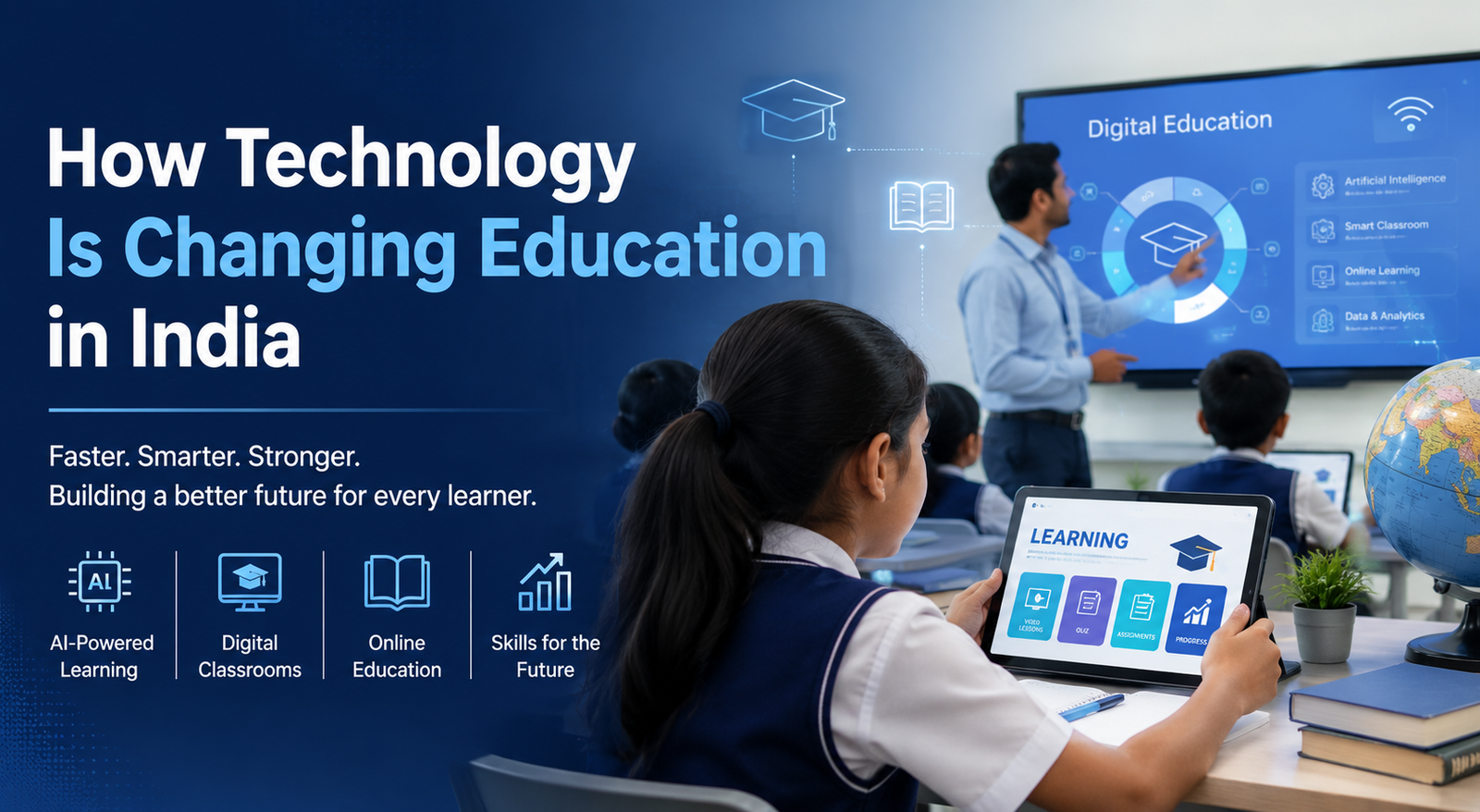
India’s education system is undergoing one of the biggest transformations in its history. Technology is rapidly changing how students learn, how teachers teach, and how institutions prepare students for future careers.
From AI-powered classrooms and online learning platforms to smart assessments and virtual tutoring, education in India is becoming more digital, personalized, and skill-focused than ever before.
The shift that started during the pandemic has now evolved into a long-term digital education revolution.
The Rise of AI in Indian Education
Artificial Intelligence is becoming one of the most influential technologies in Indian education.
Schools, colleges, and EdTech companies are increasingly using AI tools to personalize learning experiences, automate assessments, and provide students with real-time feedback.
Reports suggest that India is adopting AI in education at more than double the global average.
AI-powered systems can now identify student weaknesses, recommend customized lessons, and provide additional practice based on learning patterns.
Many schools are also integrating AI and coding into their curriculum to prepare students for future careers. In Telangana, law colleges have already started introducing AI-focused education and legal technology training.
Smart Classrooms Are Becoming the New Normal
Traditional blackboard teaching is gradually being replaced by smart classrooms.
Modern classrooms now use:
- Interactive digital boards
- AI-powered learning software
- Online assessments
- Video-based explanations
- Real-time performance tracking
Companies like Extramarks are building AI-driven connected classroom systems that allow teachers, students, and parents to stay digitally connected.
These technologies help improve engagement and make learning more interactive compared to traditional teaching methods.
Online Learning Platforms Are Expanding Rapidly
India’s online learning ecosystem has grown significantly in recent years.
Platforms like SWAYAM Plus, Coursera, and other EdTech platforms are helping students learn beyond traditional classrooms.
IIT Madras-led SWAYAM Plus recently crossed 5.5 lakh learners and launched beginner-friendly AI courses under its “AI for All” initiative.
Students today can access:
- Recorded lectures
- AI tutors
- Skill certification programs
- Industry-based courses
- Virtual doubt-solving sessions
This accessibility is especially important for students living in smaller towns and rural areas where quality educational infrastructure may still be limited.
Personalized Learning Is Changing Student Experiences
One of the biggest advantages of technology in education is personalized learning.
Unlike traditional classrooms where every student follows the same pace, AI systems can now adapt lessons according to individual learning speed and understanding.
Modern AI tutors analyze strengths and weaknesses in real time and recommend customized exercises.
This makes learning more effective because students receive targeted support instead of generic teaching.
Research also shows that AI-powered learning systems can improve student performance and course completion rates significantly.
Technology Is Creating Skill-Based Education
The Indian job market is changing rapidly, and educational institutions are responding accordingly.
Today, students are increasingly focusing on skills instead of only degrees. Courses related to AI, cybersecurity, data science, coding, digital marketing, and analytics are becoming highly popular.
Universities are now partnering with technology companies to provide industry-ready education. For example, Vignan’s University recently partnered with Intel India to strengthen AI education and certification programs.
This shift is helping students become more employable in a technology-driven economy.
Challenges of Technology in Education
Although technology has transformed education positively, there are still several concerns.
Experts warn that excessive dependence on AI tools may reduce critical thinking and problem-solving abilities among students.
There are also challenges related to:
- Digital divide in rural areas
- Internet accessibility
- Screen-time concerns
- Data privacy
- Teacher training
Many teachers are still adapting to AI-driven education systems, and institutions need better training programs to fully utilize these technologies.
Teachers Are Still Essential
Despite rapid technological growth, teachers continue to play a crucial role in education.
AI can support learning, but it cannot replace human interaction, emotional understanding, mentorship, and classroom guidance.
Experts believe the future of education will involve collaboration between teachers and technology rather than replacement.
Teachers who effectively combine digital tools with human teaching methods are likely to create the best learning experiences for students.
The Future of Education in India
India is moving toward a future where education becomes more flexible, skill-driven, and technology-enabled.
AI-powered classrooms, smart assessments, virtual tutors, and online certification programs are likely to become even more common over the next few years.
The goal is no longer just memorizing information. Modern education is increasingly focused on creativity, analytical thinking, adaptability, and practical skills.
As India continues its digital transformation journey, technology will play an even bigger role in shaping how future generations learn and build careers.
The education system of 2026 is already very different from what it was just a few years ago — and this transformation has only just begun.